

Introduction: The Changing Winds of Indian Education
Imagine two fresh graduates walking out of a university gate in India today. Both hold identical degrees in their hands—perhaps an engineering B.Tech or a B.Com. On paper, they are equals. Yet, when they enter the rigorous battlefield of the job market, their paths diverge drastically. One struggles to land an interview, finding their theoretical knowledge disconnected from industry reality. The other secures multiple offers, adapts quickly, and begins a thriving career.
What is the differentiator? It is no longer just the university brand name or the marks secured in final exams. The differentiator is skill.
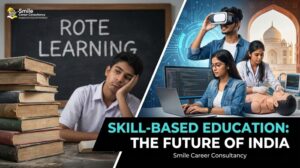
For decades, the Indian education narrative has been dominated by a “marks-first” mentality. The goal was to memorize, regurgitate in exams, secure a high percentage, and obtain a certificate. This system served a purpose in a different era, but in the rapidly evolving 21st century—driven by automation, artificial intelligence, and global integration—this traditional model is showing significant cracks.
We are standing at a pivotal juncture in India’s growth story. With one of the youngest populations in the world, our demographic dividend can only be realized if our youth are not just educated, but employable. This realization is driving a massive paradigm shift towards Skill-Based Education. It is no longer an optional add-on; it is the absolute prerequisite for the future success of our nation and its individuals.
At Smile Career Consultancy, located here in the heart of Kolkata at Santoshpur, we witness this shift daily. Parents and students are no longer just asking, “Which college will give the best degree?” They are increasingly asking, “Which path will give me the skills to succeed globally?” This blog explores why skill-based learning is the undeniable future of India and how it reshapes career trajectories, from engineering to medicine.
Section 1: The “Diploma Disease” and the Employability Gap
To understand the urgency of skill-based education, we must first confront the reality of the current landscape. India churns out millions of graduates every year. Yet, major industry reports and employability surveys consistently highlight a startling paradox: we have a surplus of degree holders but a severe shortage of skilled talent.
This phenomenon is often called the “diploma disease”—the endless pursuit of higher qualifications solely for the sake of credentials, without a corresponding increase in real-world competency.
The Core Problems with the Traditional Model:
-
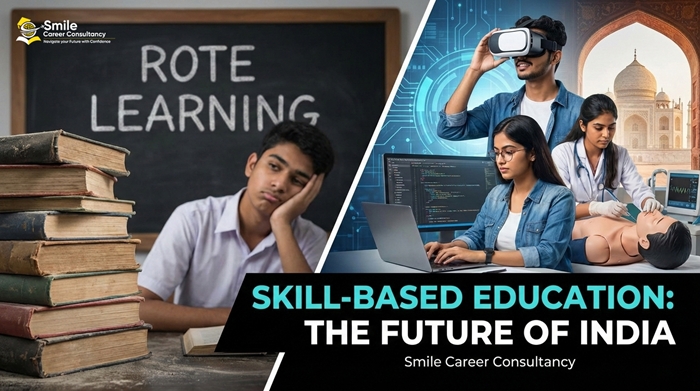
Rote Learning Over Critical Thinking: The traditional system often rewards memory over understanding. Students learn the “what” but rarely explore the “how” and “why.” When faced with a novel problem in a workplace setting, they lack the critical thinking framework to solve it.
-
Outdated Curricula: Technology and industry standards change every six months. Academic syllabi, however, often take years to update. This means students are frequently learning concepts that became obsolete before they even graduated.
-
The “Soft Skills” Void: Technical knowledge is essential, but it’s only half the battle. The traditional classroom rarely emphasizes communication, teamwork, emotional intelligence, and adaptability. Yet, employers repeatedly rank these “soft skills” as top hiring priorities.
The result is an “employability gap.” Industries—from IT to healthcare—are forced to invest heavily in retraining fresh graduates because their academic foundation didn’t prepare them for the practical demands of the job.
Section 2: Defining Skill-Based Education (It’s More Than Vocational Training)
There is a common misconception that “skill-based education” only refers to vocational training like carpentry, plumbing, or basic computer repairs. While these are vital skills, the modern definition is far broader.
Skill-based education is an approach to learning where the primary focus is on acquiring and applying practical knowledge and competencies, rather than mere theoretical retention. It is about bridging the gap between knowing something and being able to do something.
The Core Pillars of Skill-Based Learning:
-
Application-Oriented: Every theoretical concept is immediately paired with a practical application. If you learn about coding syntax, you build an app. If you learn about human anatomy, you spend time in clinical simulation or dissection.
-
Problem-Solving Focus: Instead of standard questions with single correct answers, students are presented with real-world scenarios and challenged to find viable solutions.
-
Interdisciplinary Approach: Real-life problems rarely fall neatly into “physics” or “economics” buckets. Skill-based education encourages combining knowledge from different fields to innovate.
-
Continuous Assessment: Instead of one high-stakes final exam, evaluation is ongoing through projects, presentations, portfolios, and practical demonstrations of competence.
Whether a student is pursuing an MBBS degree abroad or a Digital Marketing course in India, the education is only truly valuable if it is anchored in skill development.
Section 3: The Drivers Fueling the Skills Revolution in India
Why is this shift happening now? Several powerful forces are converging to make skill-based education inevitable in India.
1. The National Education Policy (NEP) 2020: The Government of India has recognized the crisis. The NEP 2020 is a landmark document aiming to overhaul the system. It explicitly emphasizes moving away from rote learning towards critical thinking and integrates vocational education from a young age. It signals a top-down commitment to valuing skills alongside academics.
2. The Impact of Automation and AI: We cannot ignore the technological elephant in the room. Artificial Intelligence and automation are rapidly making routine cognitive jobs obsolete. Roles that involve repetitive data entry or basic calculations are disappearing. The jobs of the future will require human skills that machines cannot easily replicate: complex problem-solving, creativity, empathy, and strategic negotiation. A purely theoretical education does not build these capabilities.
3. The Globalized Job Market: Today’s Indian student isn’t just competing with peers in Mumbai or Delhi; they are competing with talent from Singapore, Berlin, and Silicon Valley. Global employers demand global standards of competence. International universities—many of which we at Smile Career Consultancy help students access—have long recognized this, integrating robust practical training into their curriculums, particularly in fields like medicine and engineering.
4. The Startup Ecosystem and Entrepreneurship: India has the world’s third-largest startup ecosystem. Startups don’t care about your marksheet; they care about your hustle and what you can build. This ecosystem thrives on distinct skills—coding, digital marketing, product design, and sales—fueling demand for education that delivers these results quickly.
Section 4: The New Currency—Skills for the 21st Century Indian Student
If skills are the new currency, what should Indian students be stocking up on? The required skills fall into two main buckets, both equally important.
The “Hard” Skills (Domain Specific): These depend on the career path but are increasingly driven by technology.
-
Data Literacy: The ability to read, analyze, and communicate with data is becoming essential in every field, from marketing to healthcare management.
-
Technological Proficiency: Depending on the field, this could mean coding, understanding cloud computing, or mastering sophisticated medical diagnostic equipment.
-
Specialized Knowledge Application: For a medical student, this isn’t just knowing Gray’s Anatomy; it’s the skill of accurate diagnosis, patient interaction, and clinical procedure under pressure.
The “Power” Skills (Formerly Soft Skills): Often harder to teach but crucial for long-term success.
-
Adaptability and Resilience: The job market will change many times over a student’s career. The ability to “learn how to learn” and bounce back from failure is paramount.
-
Communication and Collaboration: The brilliant lone wolf is less valuable than the effective team player who can articulate ideas clearly across diverse groups.
-
Empathy and Emotional Intelligence: Particularly vital in healthcare and leadership roles. Machines cannot empathize with a patient or motivate a struggling team member.
Section 5: Bridging the Gap—The Role of Smile Career Consultancy
At Smile Career Consultancy, we understand that the transition to a skill-based mindset can be overwhelming for students and parents conditioned by the old system.
Based in Santoshpur, Kolkata, we have spent years guiding students not just toward admission letters, but toward educations that build careers. We believe that even traditional, high-prestige paths like medicine (MBBS) must be viewed through a skills lens.
How We Champion Skill-Based Choices in Study Abroad:
When families come to us seeking admission guidance—particularly for popular options like MBBS in Bangladesh or other international destinations—our counseling goes beyond fees and eligibility. We focus on the quality of skill acquisition offered by the institution.
-
Evaluating Clinical Exposure: For medical aspirants, a degree without extensive, hands-on clinical training is dangerous. We guide students toward universities known for high patient inflow in their attached hospitals, ensuring students gain the practical skills requisite for a successful doctor, not just bookish knowledge.
-
Transparent Guidance: Skill-based education requires making informed choices. We pride ourselves on the transparency mentioned in our local reviews (4.8/5 rating). We ensure students understand the reality of the curriculum, the licensing exam requirements (like FMGE/NExT), and the genuine skill value of the foreign degree they are pursuing.
-
Career Roadmap Design: Counseling is itself a skill. We help students identify their strengths and match them with educational paths that will develop marketable competencies. We don’t just want you to get in; we want you to remain employable out there.
We believe that navigating the complex landscape of international education requires a partner who values competence over mere credentials.
Conclusion: Embracing the Future Today
The debate is over. The future of India belongs to the skilled.
The shift from a certificate-based economy to a skill-based economy is not a temporary trend; it is a fundamental restructuring of how we work and live. For students in Kolkata and across India, this is good news. It levels the playing field. It means that your potential is no longer dictated solely by an exam you took at age 18, but by your continuous willingness to learn, adapt, and master new competencies.
It requires a mindset shift from parents, educators, and policymakers. We must stop asking “How much did you score?” and start asking “What can you build? What can you solve? What can you do?”
Embracing skill-based education is the only way to ensure that India’s massive youth population becomes an engine of economic power rather than a generation of underemployed degree-holders. The future is bright, but it must be built with skilled hands.
Ready to build a career founded on real-world skills? Contact Smile Career Consultancy today. Let our experienced team in Santoshpur, Kolkata, guide you toward educational paths—whether in India or abroad—that ensure you are future-ready.
📍 Visit Us: B-265, Survey Park, Santoshpur, Near Kishore Bharati Stadium, Kolkata.